
Work and Rewards By THE EDITORIAL BOARD Job numbers are stronger than expected, but many jobs still do not pay enough for workers to make a decent living.
Economist:
Minimum wages
What sort of floor?
Dec 3rd 2013, 11:23 by R.A. | LONDON
AROUND the world, momentum is building for increases in minimum wage rates. SeaTac, Washington, a Seattle suburb that is home to a large metropolitan airport, backed a $15 per hour minimum wage law last week. On Thursday of this week fast-food workers around America will strike for one day, demanding a $15 per hour base rate for the industry. A majority of Americans favour increases (even a majority of Republicans), and President Obama has signalled his support for a bill raising the national minimum wage to $10. Germany’s new coalition has backed a national minimum wage of €8.50 ($11.50).
What might higher minimum wage rates mean for workers? In the most basic economic story, marginal workers are paid their marginal productivity, and an increase in the minimum wage will therefore reduce overall employment. Economists began rethinking that most simple of models in the 1990s, when new research revealed that higher minimum wages /didn’t necessarily have the expected employment effects. Some reckoned that frictions in the labour markets, like the cost to workers of searching for obtaining new jobs, gave firms bargaining power that allowed them to take an outsized share of the gains from the hire. A cleverly designed minimum wage could, in that case, raise worker pay without reducing employment. ?
Last year, a Free exchange column took a look at the current state of the debate within economics:
America’s academics still do not agree on the employment effects. But both sides have honed their methods and, in some ways, the gap between them has shrunk. Messrs Card and Krueger moved on to other work, but Arindrajit Dube at the University of Massachusetts-Amherst and Michael Reich of the University of California at Berkeley have generalised the case-study approach, comparing restaurant employment across all contiguous counties with different minimum-wage levels between 1990 and 2006. They found /no adverse effects on employment from a higher minimum wage. They also argue that if research showed such effects, these mostly reflected other differences between American states and had nothing to do with the minimum wage. ??
Messrs Neumark and Wascher still demur. They have published stacks of studies (and a book) purporting to show that minimum wages hit jobs. In a forthcoming paper they defend their methods and argue that the evidence still favours their view. But even they are no longer blanket opponents. In a 2011 paper they pointed out that a higher minimum wage along with the Earned Income Tax Credit (which tops up income for poor workers in America) boosted both employment and earnings for single women with children /(though it cost less-skilled, minority men jobs). hmm
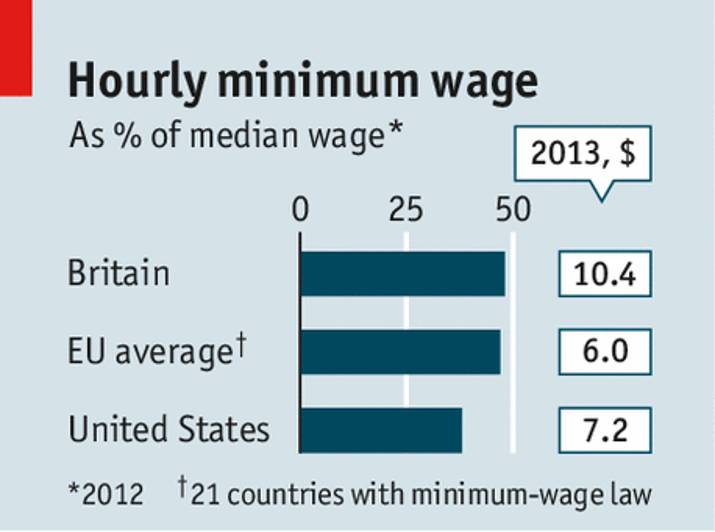
Britain’s experience offers another set of insights. The country’s national minimum wage was introduced at 46% of the median wage, slightly higher than America’s. A lower floor applied to young people. Both are adjusted annually on the advice of the Low Pay Commission. Before the law took effect, worries about potential damage to employment were widespread. Yet today the consensus is that Britain’s minimum wage has done little or no harm.
The most striking impact of Britain’s minimum wage has been on the spread of wages. Not only has it pushed up pay for the bottom 5% of workers, but it also seems to have boosted earnings further up the income scale—and thus reduced wage inequality. Wage gaps in the bottom half of Britain’s pay scale have shrunk sharply since the late 1990s. A new study by a trio of British labour-market economists (including one at the Low Pay Commission) attributes much of that contraction to the minimum wage. Wage inequality fell more for women (a higher proportion of whom are on the minimum wage) than for men and the effect was most pronounced in low-wage parts of Britain.
The finding that an increase in the minimum wage boosts pay up the wage scale, and not just for those earning the minimum wage, is fascinating but also somewhat worrying. It suggests that the minimum wage does not primarily boost pay by reallocating the surplus generated by a hire. Instead, employees seem to respond by working harder while employers invest in training and other workplace productivity boosters. That’s a lovely thing to have happen, but also reason for caution. Technological progress seems to be boosting opportunities for automation all the time, and at some point firms will cross the threshold beyond which it makes sense to replace labour with capital rather than invest in more productive labour. Amazon’s fulfillment centres generate tens of thousands of jobs, many at or near minimum wage. Maybe a higher minimum wage will lead to better pay without much of an employment effect. Or maybe Amazon will accelerate the deployment of warehouse robots. Maybe a higher minimum wage will boost pay at fast-food restaurants. Or maybe it will lead the restaurants to get serious about automation.
I think ideally we would see a push instead for greater wage subsidies to low-income workers, perhaps combined with the careful minimum wage system used in Britain to ensure that firms don’t simply shift the burden of giving market pay rises onto the state. But straightforward minimum wage hikes may be the only politically feasible way forward for low-income workers. And in some sense a rise in the minimum wage is a can’t lose proposition. If there are no employment effects then all is well. And if there are large employment effects then perhaps society will be unable to ignore the impact of automation: there may no longer be a market-clearing “living wage” for the lowest skilled workers in rich economies. And then perhaps a serious discussion, about a universal basic income, for example, or efforts to expand ownership of capital, can occur.
============================ = = = is this similar to one above?
HE LIKES the work; but at $9.60 an hour, stacking the shelves at a Walmart in east Los Angeles does not pay Anthony Goytia enough to cover the bills for his family of five, he says. He supplements his fortnightly pay of $560-600 with the odd catering job, by subjecting himself to clinical trials of a treatment for his psoriasis, and with federal and state assistance. He was recently approved for food stamps; that should make Christmas a little jollier.
America is going through one of its periodic fits of agony over the minimum wage. In recent weeks several states and municipalities have approved rate rises; most dramatically in SeaTac, a suburb of Seattle consisting of a large airport, where voters raised the hourly figure to $15. On December 4th Barack Obama called for a higher federal minimum wage. He has previously suggested that it rise from $7.25 to $10.10. It has lost 5.8% of its purchasing power since it was last raised, in 2009.
Between 1979 and 2007 the incomes of the top 1% of American earners rose by 275%, according to the Congressional Budget Office. Those of the bottom 20% rose by 18%. Had the federal minimum wage kept up with productivity gains since 1968 it would have reached $21.72 last year, estimates the Centre for Economic and Policy Research (CEPR), a leftish think-tank. Campaigners ?? gripe that the /government should not have to top up the pay of workers like Mr Goytia (who agrees); this “hidden subsidy” amounts to $7 billion in the fast-food industry alone, according to one study.
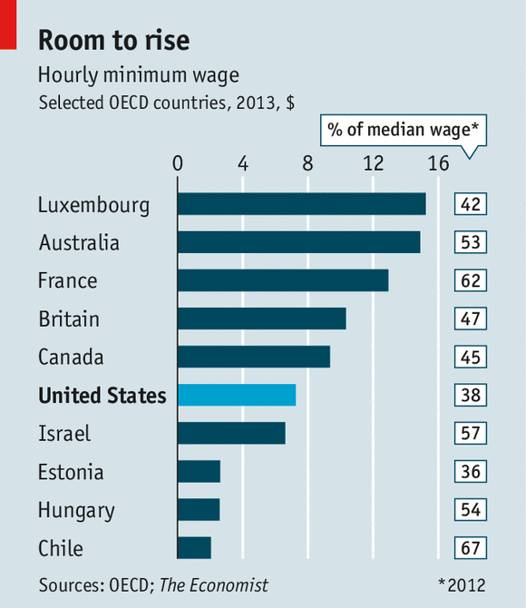
There is /no consensus among economists about the extent to which minimum wages kill jobs. But recent research suggests that relatively low rates (America’s is 38% of the median wage) are not harmful, and that small increases can be beneficial. They not only lift workers’ purchasing power; they also make them more loyal, and so reduce the amount companies must spend recruiting new people. Ffff?
Mr Obama will not convince Republicans in the House of Representatives to vote for an increase. But by raising the idea he may help Democrats in next year’s midterm elections, particularly in red states where local minimum-wage rises are on the ballot. Republican voters do not recoil at the prospect; 58% told Gallup in November that they would support a rise to $9 an hour; overall, 78% of Americans agree.
Advocates for a higher federal minimum wage point out that, in real terms, it is well below its peak in 1968. That is true, but misleading. First, the big drop came in the 1970s and early 1980s, not recently. Second, as David Neumark of the University of California, Irvine, has pointed out, the /earned-income tax credit, a federal subsidy for low-wage workers, makes up for a lot of the losses.
Moreover, the /proliferation of state and municipal minimum wages means that the /federal rate covers far fewer people than it once did. In 1979 7.9% of workers toiled at or below the federal minimum wage; last year 2.8% did. From January 1st 21 states will have a minimum wage higher than the federal one (see map). More may introduce one next year; others will raise theirs further.
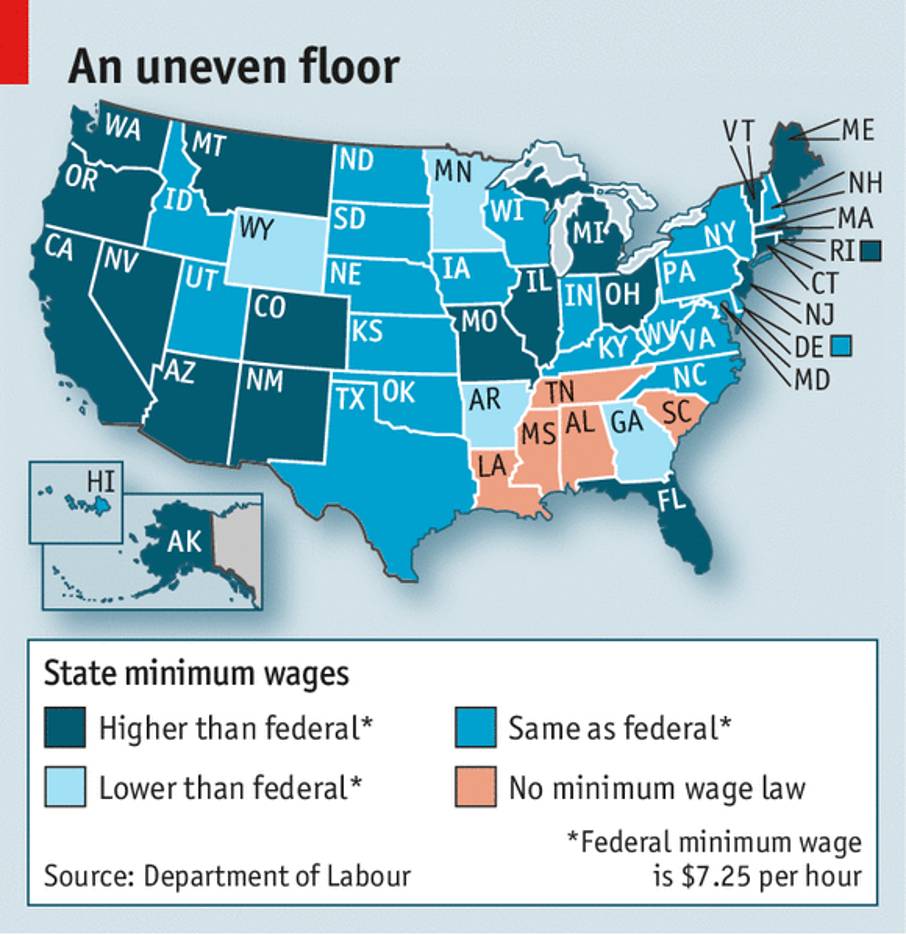
Variable minimum wages make sense for a large country with /variable costs of living. But they can have unexpected consequences. The campaign in SeaTac became a big issue during the concurrent mayoral race in Seattle; there, both candidates backed a $15 rate. John Burbank of the Seattle-based Economic Opportunity Institute now reckons the city will approve a $15 rate next year. Washington, DC and two neighbouring counties recently co-ordinated huge rate rises to stop firms playing them off against each other. ??
Such quirks are inevitable when politicians are left in charge. Most countries with a minimum wage outsource rate-setting to independent /technocrats. Eleven American states and several cities index their rates to inflation; this can be awkwardly inflexible when economies stumble, but it does mean firms and workers avoid nasty shocks. Elsewhere, and at the federal level, minimum wages are subject to the fancies of politicians and voters.
Some agitators for higher pay focus on specific industries or companies, such as McDonald’s. Last week hundreds of union-backed workers went on the latest of a series of nationally co-ordinated strikes calling for a $15 wage. That figure, according to a recent business-backed survey, would lead to “personnel decisions” (management-speak for /cutting jobs or hours) at 86% of fast-food and other franchises. Ron Shaich, the boss of Panera, a chain of 1,800 eateries, is an exception in the industry; he backs an increase in the minimum wage so long as it applies to everyone. [<-odd to add this here]
Other business leaders feel differently. The solution to the “wage problem” said Jim McNerney, the boss of Boeing, this week, is not a minimum wage but “an economy that’s growing”. But John Schmitt of the CEPR says the demand for a $15 wage is best understood /as a broader push for collective-bargaining rights. Perhaps some employers can be convinced to pay higher wages as part of a strategy to reduce job churn, he suggests. ff
This happened with caretakers (janitors) in the late 1990s, after a decade of campaigns. An industry once staffed by ill-paid part-timers now pays workers in unionised cities $15 or more an hour. End. Bias?
/where states have no mw, fed mw applies.
Economist, same issue, date as above:
Moderate minimum wages do more good than harm. They should be set by technocrats not politicians
Dec 14th 2013 | From the print edition
ON BOTH sides of the Atlantic politicians are warming to the idea that the lowest-paid can be helped by mandating higher wages. Barack Obama wants to raise America’s federal minimum wage by 40% from $7.25 to $10.10 an hour, and more than three-quarters of Americans support the idea (see article). In Germany, one of the few big rich-world countries still without a national wage floor, the incoming coalition government has just agreed on an across-the-board hourly minimum of €8.50 ($11.50) from 2015. In Britain, which has had a minimum wage since 1999, the opposition Labour Party is keen to cajole firms into “voluntarily” paying higher “living wages”.
In this section
- Invictus
- Would Modi save India or wreck it?
- Goodbye, Putin
- Life after Doha
- The logical floor
- Hedge-trimming
Related topics
For free-market types, including The Economist, fiddling with wages by fiat sets off alarm bells. In a competitive market anything that artificially raises the price of labour will curb demand for it, and the first to lose their jobs will be the least skilled—the people intervention is supposed to help. That is why Milton Friedman called minimum wages a form of discrimination against the low-skilled; and it is why he saw topping up the incomes of the working poor with public subsidies as a far more sensible means of alleviating poverty.
Scepticism about the merits of minimum wages remains this newspaper’s starting-point. But as income inequality widens and workers’ share of national income shrinks, the case for action to help the low-paid grows. Addressing the problem through subsidies for the working poor is harder in an era of austerity, when there are many other pressing claims on national coffers. Other policy options, such as confiscatory taxes, are unattractive.
Nor is a moderate minimum wage as undesirable as neoclassical purists suggest. Unlike those in textbooks, real labour markets are not perfectly competitive. Since workers who want to change jobs face costs and risks, employers may be able to set pay below its market-clearing rate. A minimum wage, providing it is not set too high, could thus boost pay with no ill effects on jobs.
French lessons
Empirical evidence supports that argument. In flexible economies a low minimum wage seems to have little, if any, depressing effect on employment. America’s federal minimum wage, at 38% of median income, is one of the rich world’s lowest. Some studies find no harm to employment from federal or state minimum wages, others see a small one, but none finds any serious damage. Britain’s minimum wage, at around 47% of median income, with a lower rate for young people, also does not seem to have pushed many people out of work.
High minimum wages, however, particularly in rigid labour markets, do appear to hit employment. France has the rich world’s highest wage floor, at more than 60% of the median for adults and a far bigger fraction of the typical wage for the young. This helps explain why France also has shockingly high rates of youth unemployment: 26% for 15- to 24-year-olds.
Theory and practice suggest two lessons for governments contemplating setting or changing minimum wages. The first is to ensure that the level is pretty low—say, less than 50% of the median, with lower levels for less productive people such as the young and long-term unemployed. Germany risks breaking this rule. Its proposed level is, by one calculation, 62% of the median wage. One in six German workers is paid less than that, suggesting that jobs will be lost, especially in the less productive east of the country. Similarly the “living wage” which campaigners are calling for in Britain is 20% higher than the minimum wage. That could hit employment. Though America’s proposed increase is huge, the minimum wage would still be only about 50% of the median.
A second lesson is that politicians should give the power to set minimum wages to technocrats. In Britain, the floor is adjusted annually on the advice of economists and statisticians in the Low Pay Commission; it has generally advanced gradually. In America, the federal floor is set by politicians and adjusted irregularly in huge increments. That does no favours to American workers or their employers.
Finally, governments should remember that minimum wages are a palliative. They should not distract attention from more fundamental causes of low wages—such as a lack of education and skills—and the efforts to address them. —————— – – end
————— – – –
Frank Woolworth and the Minimum WageBy Zac Thompson and Daniel J. Smith Frank Woolworth wound up benefiting millions of consumers and employees. Minimum-wage laws would have made it all impossible. |
—————————————- – – –
|

Blow: Minimum Wage, Maximum Outrage
British business groups criticized the opposition Labour Party’s plan to link the national minimum wage to average earnings.
———– – –
/skip first half? – A higher minimum wage — at what cost? La 5/l4
/ Automation arrives at restaurants (but don’t blame rising minimum wages)
A Wall Street Journal editorial this week, “Minimum Wage Backfire,” said that while it may be …
——————————— – – – – –
http://www.latimes.com/search/dispatcher.front?Query=minimum+wage+alpert&target=all thus
Three studies of L.A. minimum wage boosts reach different conclusions
Emily Alpert Reyes
Would boosting L.A.’s minimum wage to $13.25 or $15.25 an hour … whether the city should increase the minimum wage as part of a national push to reduce … proposed a gradual increase in the minimum wage to $13.25 by 2017, with future …
/graphs – benefits of no mw –
——————– – – –
The Alamo and Walmart By GAIL COLLINS There’s a whole new way to mess with Texas.
http://www.wsj.com/articles/better-than-raising-the-minimum-wage-1432249927?mod=trending_now_2
/lst one shows how ingenious they are at missing the pt – http://www.latimes.com/search/dispatcher.front?Query=minimum+wage+walton&target=all
Op-Ed ContributorConnecting Young People With Jobs By HOWARD SCHULTZ and SHERI SCHULTZPhilanthropies, companies and government will work together to hire 100,000 young people over three years. |
Brooks: The Minimum-Wage Muddle 7/l5
Raising Floor for Minimum Wage Pushes Economy Into the Unknown By NOAM SCHEIBER Researchers have little experience with raises of such magnitude. The effects, especially in areas with low median incomes, could be profound.

A Company Copes With Backlash Against the Raise That Roared
—————— – –
- Opinion: Another Minimum Wage Backfire wsj but locked
/Incomes and Outcomes: What a $15 Minimum Wage Would Mean for Your City
Minimum-Wage Waivers for Unions Stir Standoff

As Minimum Wages Rise, Restaurants Say No to Tips, Yes to Higher Prices
/ does this fit? Nail Salon Owners Sue Cuomo and New York State Over Wage Bond Requirement
https://www.google.com/?gws_rd=ssl#q=higher+minimum+wage
——————————————– – – – – –
Birmingham Fights Back on the Minimum Wage
https://www.google.com/#q=how+the+puerto+rico+bill+attacks+minimum+wage
————————————————————————————– – – –

California minimum wage hike hits L.A. apparel industry: ‘The exodus has begun’
Shan Li and Natalie Kitroeff
Los Angeles was once the epicenter of apparel manufacturing, attracting buyers from across the world to its clothing factories, sample rooms and design studios. But over the years, cheap overseas labor lured many apparel makers to outsource to foreign competitors in far-flung places such as China…
——————————— – – –
Op-Ed: A Better Way to Raise Incomes
Expanding the earned-income tax credit will do more to fight poverty than raising the minimum
/title of article , so search it higher mw may have losers inyt
South Africa, a Nation With Sharp Inequality, Considers a Minimum Wage By NORIMITSU ONISHI The move would help reduce poverty and inequality, supporters say, but opponents contend it would worsen already high unemployment. 2/l7 |

/finally confirmation of ag: ll/l7
 |
By JONATHAN COWAN and JIM KESSLER
Prices are different all over America. Regional minimums should be, too.
/nyt 2/2l: won’t click
Biden Wants a $15 Minimum Wage. Here’s What People Say It Would Do to the Economy.